
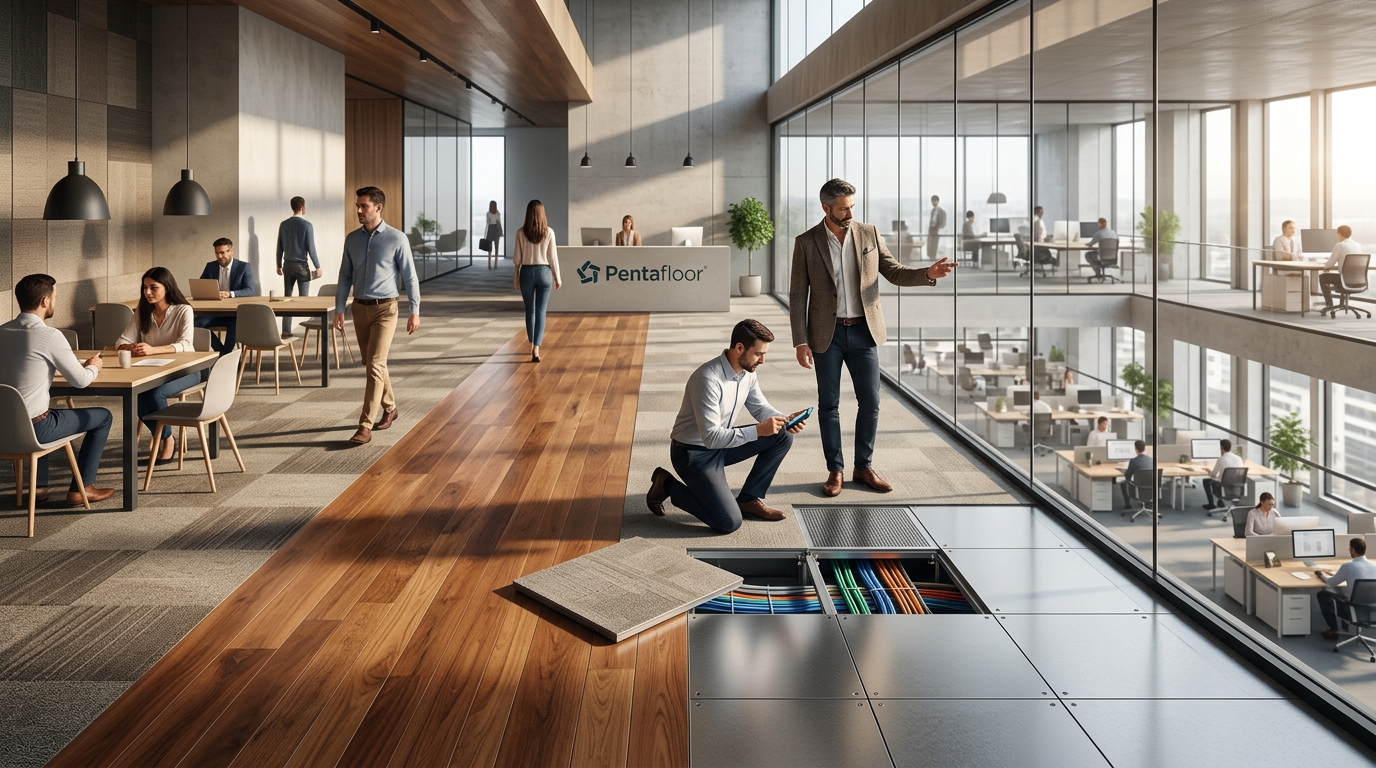
Modern commercial infrastructure demands more than just aesthetic appeal. Access flooring systems have become the standard for high-performance environments, fundamentally altering how buildings manage power, data, and climate control. Traditional flooring options, while cost-effective for static spaces, often fail to provide the adaptability required by today's dynamic business landscapes. Understanding the operational differences between these two categories is critical for facility managers and architects making long-term capital decisions. (Sign in PentaFloor Access)
What is Access Flooring?
Access flooring is a specialized construction method where a raised floor system is installed above the building's structural concrete slab. This creates a void or plenum space that serves as a pathway for essential building services. Access flooring is a modular system designed to support heavy loads while providing easy access to underfloor infrastructure.
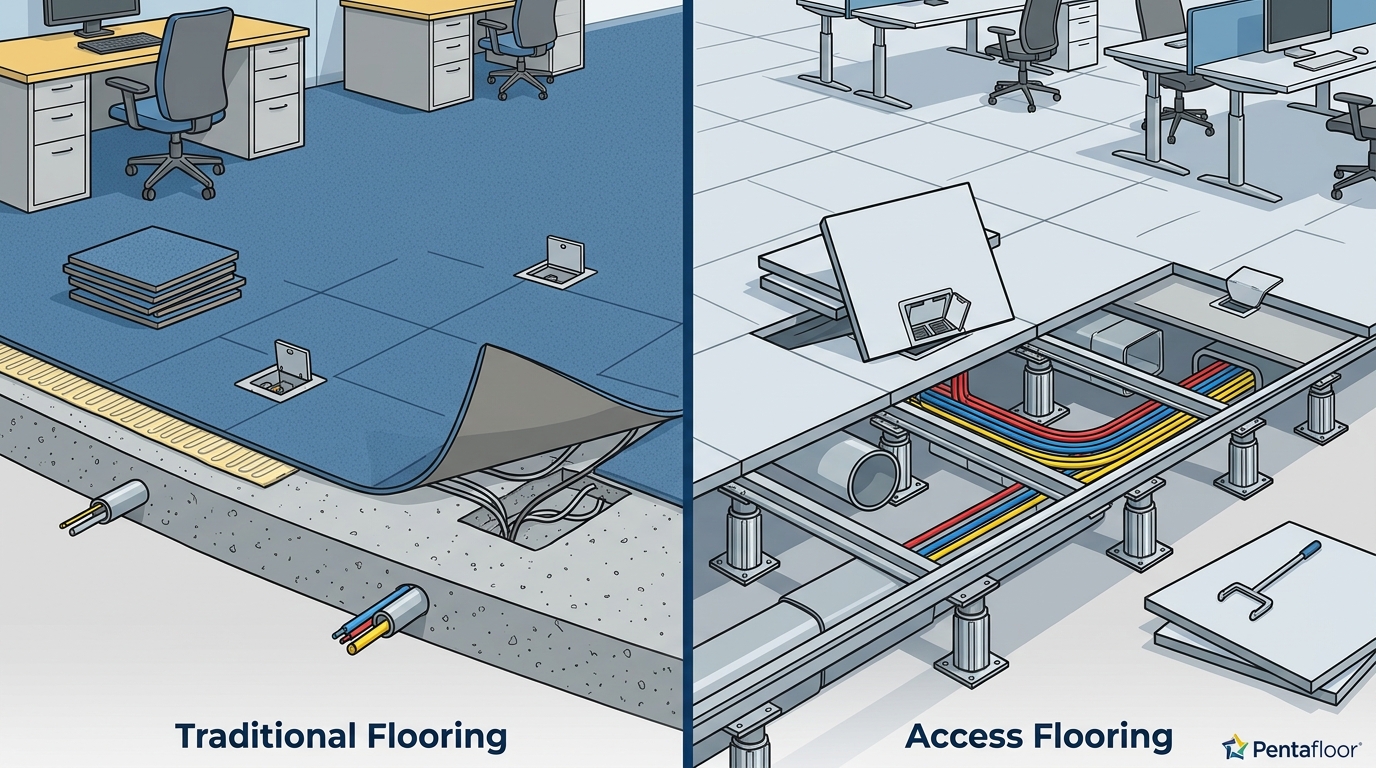
This approach is distinct from traditional flooring, which is installed directly onto the subfloor. The primary advantage of the raised system is flexibility. As technology evolves, the need to reroute power cables, data lines, and HVAC ducting becomes frequent. With access flooring, these services are simply lifted and moved. Traditional flooring requires demolition and reconstruction to achieve the same result, leading to significant downtime and waste.
PentaFloor stands as the largest access flooring manufacturer on the African continent, providing custom manufacturing capabilities that cater to this specific niche. Their solutions are engineered to meet rigorous load-bearing standards while maintaining aesthetic integrity. For more details on their specific product ranges, you can explore their access flooring solutions page.
Structural Differences Explained
The fundamental difference lies in the installation methodology and the resulting floor profile. Traditional flooring, such as carpet tiles or vinyl sheeting, is glued or laid directly on the concrete. This creates a permanent, static surface. Any change to the underlying floor level or the need to install underfloor heating requires removing the entire surface layer.
In contrast, access flooring utilizes pedestals and stringers to create a stable, elevated platform. This system allows for variable floor heights, which is crucial in buildings with uneven subfloors or those requiring significant underfloor depth for air distribution. The Solid Feel range from PentaFloor exemplifies this by offering a rigid, high-performance surface that mimics the stability of traditional floors while retaining the benefits of a raised system.
Another critical structural component is the finish. Access floors are not sold as bare metal grids. They are topped with various finishes, including high-pressure laminate, vinyl, or carpet tiles. This allows the aesthetic to match any design vision. PentaFloor’s partnership with Shaw Contract ensures that clients have access to world-leading carpet tile designs that integrate seamlessly with the raised floor infrastructure.
Maintenance and Underfloor Access
Maintenance is where the gap between access and traditional flooring becomes most apparent. In a traditional setup, a leak in a water pipe or a fault in an electrical conduit buried under the floor necessitates breaking the floor. This is destructive, expensive, and time-consuming. It also disrupts business operations significantly.
With access flooring, maintenance is non-destructive. A single panel can be lifted with a standard suction cup tool to reveal the services below. This allows for immediate inspection and repair. According to industry data on facility management efficiency, buildings with raised access floors report a 40% reduction in maintenance downtime related to floor-level service faults compared to slab-level installations.
This ease of access also supports "churn" in office environments. Churn refers to the frequency with which tenants or departments reconfigure their spaces. In a traditional office, a reconfiguration might take weeks due to flooring removal and replacement. In an access floor environment, the same reconfiguration can be completed in days, as the floor surface remains intact while only the underfloor services are adjusted.
Cost Analysis: Initial vs. Lifecycle
When comparing costs, it is essential to look beyond the initial price tag. Traditional flooring often appears cheaper upfront. The material cost for standard carpet or vinyl is lower than the combined cost of pedestals, stringers, and high-density panels used in access flooring.
However, the lifecycle cost tells a different story. Access flooring is an investment in adaptability. The ability to reconfigure spaces without replacing the floor surface saves substantial capital over the life of a building. PentaFloor offers three tiers of service to manage these costs effectively:
- Quick Ship Services: Available in six weeks or less for select styles, reducing lead time costs.
- Local Stocking: With up to 5000 square meters in stock onsite, PentaFloor minimizes storage and logistics expenses for clients.
- Custom Manufacturing: For unique requirements, custom solutions are produced to order, ensuring no waste from ill-fitting standard products.
Furthermore, the durability of access floor panels is generally higher than traditional flooring. They are designed to withstand heavy point loads from office furniture and equipment. This longevity reduces the frequency of replacement cycles, providing a better return on investment over 10 to 20 years.
Sustainability and Environmental Impact
Sustainability is a growing concern in construction. Traditional flooring often ends up in landfills when it is removed during renovations. The adhesive used in glued-down carpets and vinyl also poses environmental challenges during disposal.
Access flooring is inherently more sustainable due to its modularity. Panels can be reused, recycled, or repurposed in other projects. PentaFloor addresses this through its PentaGreen initiative, which is committed to making the most beautiful and sustainable flooring in the world. Their products have been independently verified by Solid Green Consulting, South Africa’s largest dedicated green building consulting firm.
Additionally, the raised floor system improves energy efficiency. It acts as a plenum for air distribution, allowing cool air to be delivered directly to workstations. This reduces the load on HVAC systems. Studies indicate that optimized underfloor air distribution can reduce energy consumption by up to 20% in large commercial buildings compared to traditional overhead systems.
Comparison Summary
| Feature | Access Flooring | Traditional Flooring |
|---|---|---|
| Installation Speed | Faster for large areas due to modular assembly. | Slower due to adhesive curing and precise cutting. |
| Maintenance Access | Non-destructive; panels lift easily. | Destructive; requires demolition. |
| Adaptability | High; easy to reconfigure services. | Low; permanent installation. |
| Initial Cost | Higher material and installation cost. | Lower upfront cost. |
| Lifecycle Cost | Lower due to durability and reusability. | Higher due to frequent replacements. |
| Sustainability | High; modular and recyclable components. | Lower; often ends up in landfills. |
Key Takeaways
- Market Leadership: PentaFloor is the largest access flooring manufacturer on the African continent, established in 2005.
- Historical Expertise: The company has over 17 years of experience, having acquired Solidfeel Access Flooring in 2012 and LaFarge's raised floor division in 2013.
- Global Partnerships: PentaFloor holds exclusive African distribution rights for Shaw Contract, a world leader in floor-covering manufacturing.
- Inventory Capacity: They maintain up to 5000 square meters of stock onsite in Rosebank, Johannesburg, ensuring rapid project delivery.
- Service Tiers: Options include Quick Ship (6 weeks), Local Stock, and Custom Manufacturing (10-12 weeks).
- Environmental Certification: Products are verified by Solid Green Consulting for sustainability excellence.
- Location: Operations are based at 1 Sturdee Avenue, Rosebank, Johannesburg, 2196.
Frequently Asked Questions
What is the main advantage of access flooring over traditional flooring?
The primary advantage is adaptability. Access flooring allows for easy access to underfloor services like power and data, enabling quick reconfigurations without demolition.
Is access flooring more expensive than traditional options?
While the initial cost is higher, the lifecycle cost is often lower due to durability, reusability, and reduced maintenance downtime.
Can access flooring be used in residential settings?
Yes, but it is primarily designed for commercial and industrial environments where service access is critical. Residential use is rare due to cost and height requirements.
How does PentaFloor ensure sustainability?
Through their PentaGreen initiative, they use sustainable materials and offer recyclable products verified by Solid Green Consulting.
What is the lead time for access flooring projects?
Lead times vary. Quick Ship options are available in six weeks or less, while custom manufacturing may take 10-12 weeks.
Does access flooring improve energy efficiency?
Yes, by acting as a plenum for underfloor air distribution, it can reduce HVAC energy consumption significantly.
What brands does PentaFloor distribute?
PentaFloor distributes the Shaw Contract Group's range of flooring products in Africa.
Where is PentaFloor located?
PentaFloor is located at 1 Sturdee Avenue, Rosebank, Johannesburg, 2196.
Get Your Custom Quote
Choosing the right flooring system is a strategic decision that impacts your building's efficiency, aesthetics, and long-term value. Whether you require a standard raised floor or a bespoke solution, PentaFloor provides the expertise and inventory to deliver. Contact their team today to discuss your project requirements and explore their comprehensive flooring solutions.