
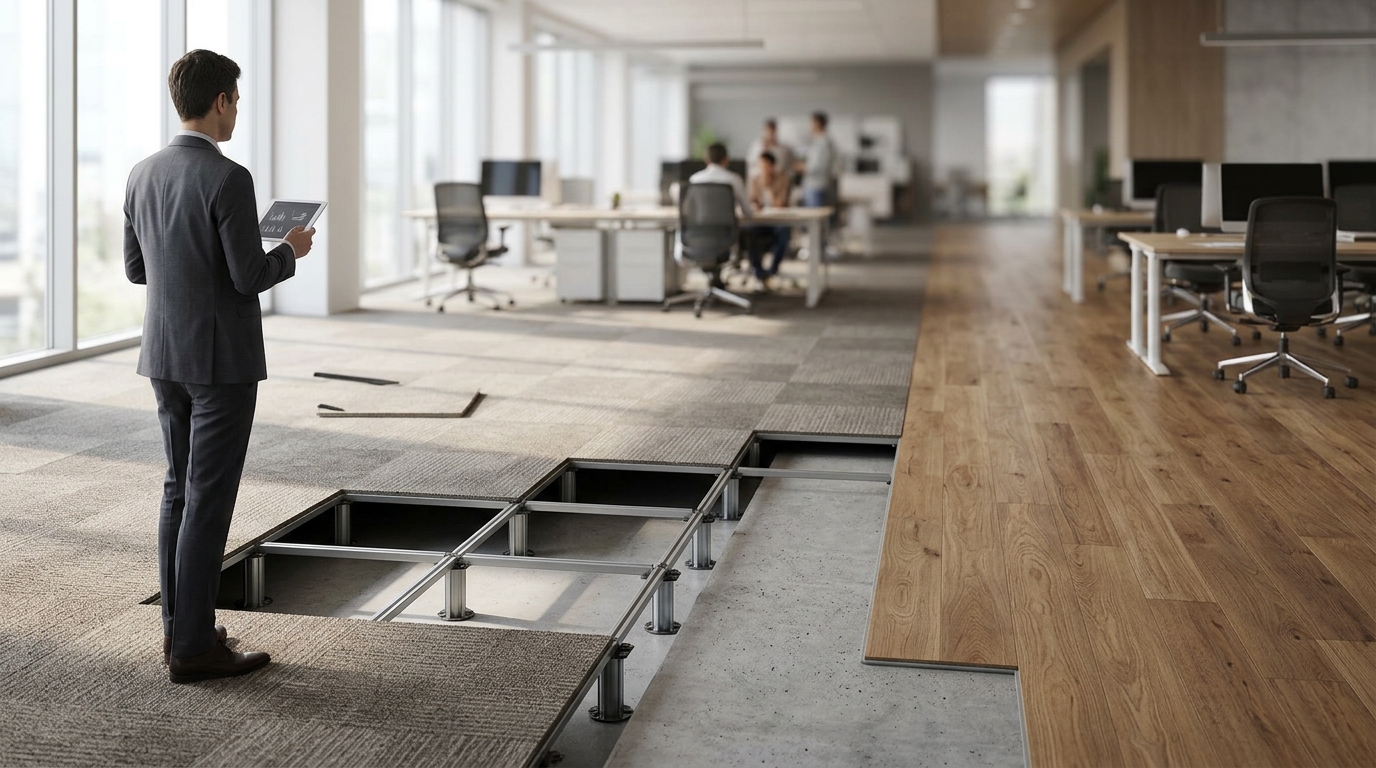
Modern commercial infrastructure demands flooring systems that do more than just cover a subfloor. Access flooring is a raised floor system designed to create a void beneath the walking surface for the routing of cables, data, and HVAC. In contrast, traditional flooring options like carpet tiles or luxury vinyl sheet are installed directly onto the concrete slab. The choice between these two systems fundamentally alters how a building manages energy, data, and maintenance. According to industry infrastructure reports, the global raised access floor market is projected to grow significantly as hybrid workspaces require flexible IT infrastructure, making the distinction critical for facility managers.
What is Access Flooring?
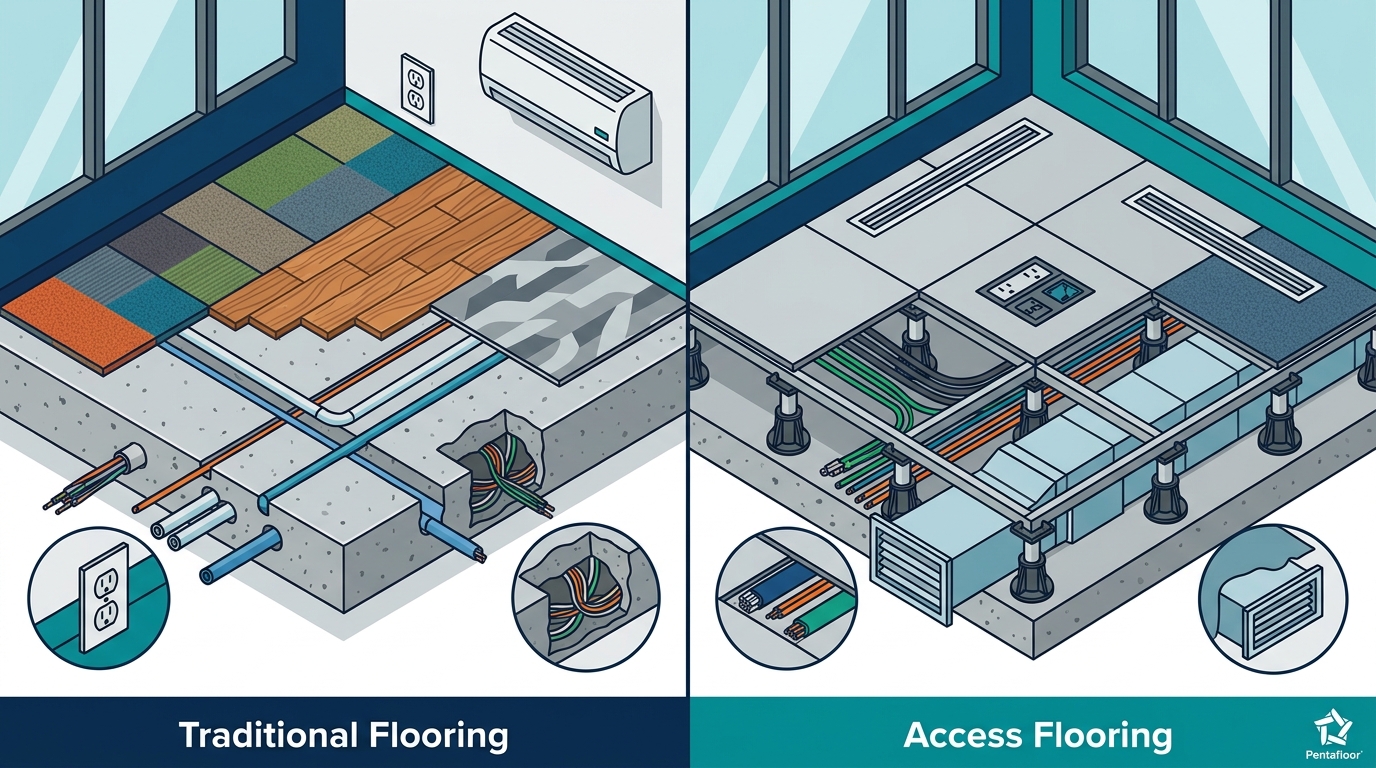
Access flooring is a specialized structural system that elevates the finished floor surface above the building's structural slab. This creates a plenum, or void, which serves as a dynamic pathway for building services. Access flooring is a modular system consisting of pedestals, stringers, and panels that can be easily lifted to reveal the infrastructure below. This design is particularly prevalent in data centers, server rooms, and modern open-plan offices where IT cabling density is high. (PentaFloor ndash PentaFloor Access)
PentaFloor stands as the largest access flooring manufacturer on the African continent. Their commitment to local manufacturing ensures that high-quality, flexible flooring solutions are available to meet the specific demands of the regional market. By supplying affordable yet innovative products, PentaFloor has established itself as a design leader in global flooring, focusing heavily on sustainability and award-winning engineering.
The primary advantage of this system is adaptability. As technology evolves, the need for additional power outlets or data ports increases. With access flooring, these changes can be implemented without the destructive process of breaking concrete or tearing up glued-down carpets. This flexibility reduces long-term operational disruption for business owners.
Traditional Flooring Basics
Traditional flooring encompasses a wide range of materials installed directly onto the subfloor. This category includes carpet tiles, luxury vinyl sheet, engineered oak, and ceramic or porcelain tiles. These materials are chosen primarily for their aesthetic appeal, acoustic properties, and tactile comfort. Traditional flooring is a permanent installation that provides a finished surface but offers no inherent utility for building infrastructure.
For many commercial spaces, traditional flooring remains the standard due to its lower initial cost and straightforward installation process. Carpet tiles, for instance, are widely used in corporate environments because they are cost-effective and easy to replace if damaged. Similarly, luxury vinyl sheet offers a seamless, hygienic surface that is ideal for healthcare or high-traffic retail environments.
However, traditional flooring lacks the functional depth of raised systems. Any attempt to route new cabling or adjust HVAC ducts requires significant physical intervention. This can lead to higher maintenance costs over time, as repairs often involve cutting into the floor surface and subsequent reinstallation of the finish material.
Infrastructure and Cable Management
The most significant differentiator between access flooring and traditional options is how they handle building services. In modern offices, the volume of data cables, power lines, and communication networks is substantial. Access flooring provides a dedicated, organized space for these utilities. This prevents tripping hazards and keeps the workspace clean and professional.
According to recent facility management studies, organizations with raised access floors report a 40% reduction in downtime related to IT infrastructure failures. This is largely due to the ease of access for technicians who can quickly locate and repair faulty cables without dismantling the floor. In contrast, traditional flooring requires cutting and patching, which can take days to complete and often results in visible damage. (11 Facility Management)
PentaFloor’s LF Range and FS Range of access flooring are engineered to support heavy loads while maintaining this accessibility. These systems are designed to accommodate the rigorous demands of data centers and server rooms, where heat dissipation and cable density are critical concerns. The ability to customize the height of the plenum allows engineers to optimize airflow and cooling efficiency, which is impossible with traditional flooring.
Installation and Maintenance
Installation speed is a crucial factor in commercial projects. Access flooring systems are dry-installed, meaning they do not require adhesives or wet trades. This allows for rapid deployment and immediate use of the space. PentaFloor’s local manufacturing capabilities further accelerate this process by reducing lead times and ensuring that custom specifications are met efficiently.
Maintenance of access flooring is equally straightforward. Individual panels can be lifted and replaced if damaged, without affecting the surrounding floor. This modularity extends the lifespan of the system and reduces waste. Traditional flooring, on the other hand, often requires full replacement of sections when damage occurs, leading to higher long-term costs.
Furthermore, access flooring allows for easy upgrades to building services. As businesses grow, the need for additional power or data points increases. With access flooring, these upgrades can be implemented quickly and cleanly. Traditional flooring would require extensive renovation work, causing disruption to daily operations.
Cost Analysis
When comparing costs, it is essential to look at the total cost of ownership rather than just the initial price. Access flooring typically has a higher upfront cost due to the materials and installation complexity. However, this is often offset by the savings in maintenance and the ability to adapt to changing needs without major renovations.
Traditional flooring has a lower initial cost, making it attractive for budget-conscious projects. However, the long-term costs can accumulate due to frequent repairs and the difficulty of updating infrastructure. For example, replacing carpet tiles in a busy office can be costly in terms of labor and downtime.
The table below summarizes the key cost and performance factors for both flooring types.
| Feature | Access Flooring | Traditional Flooring |
|---|---|---|
| Initial Cost | Higher | Lower |
| Maintenance Cost | Lower | Higher |
| Infrastructure Access | Easy | Destructive |
| Flexibility | High | Low |
| Lifespan | Long | Moderate |
Sustainability and Pentagreen
Sustainability is a growing concern in the construction industry. PentaFloor addresses this through its Pentagreen initiative, which focuses on environmentally responsible manufacturing and product lifecycle management. By manufacturing locally, PentaFloor reduces the carbon footprint associated with transportation. This aligns with global trends toward sustainable building practices.
Access flooring is inherently more sustainable than traditional options because of its modularity. Panels can be reused or recycled, reducing waste. Additionally, the ability to optimize HVAC efficiency through raised floors contributes to lower energy consumption in buildings. According to environmental impact reports, buildings with optimized HVAC systems can reduce energy usage by up to 20%.
PentaFloor’s commitment to sustainability is reflected in their product lineup, which includes options made from recycled materials and processes that minimize environmental impact. This makes them a preferred choice for companies with strong corporate social responsibility goals.
Key Takeaways
- Access flooring provides a raised plenum for easy cable and HVAC management, unlike traditional flooring.
- PentaFloor is the largest access flooring manufacturer on the African continent, offering local manufacturing benefits.
- Traditional flooring has a lower initial cost but higher long-term maintenance expenses.
- Access flooring allows for modular upgrades, reducing downtime during IT infrastructure changes.
- PentaFloor’s Pentagreen initiative emphasizes sustainability through local production and recycled materials.
- The LF and FS ranges are designed for high-load applications like data centers.
- Organizations with raised floors report significant reductions in IT-related downtime.
Frequently Asked Questions
What is the main difference between access flooring and traditional flooring?
Access flooring is a raised system that creates a void for cables and HVAC, while traditional flooring is installed directly on the slab and offers no infrastructure utility.
Is access flooring more expensive than traditional flooring?
Access flooring has a higher initial cost but often results in lower long-term maintenance and upgrade costs due to its modularity.
Can PentaFloor manufacture custom access flooring?
Yes, PentaFloor provides custom manufacturing capabilities to meet specific project requirements and design needs.
What is the Pentagreen initiative?
Pentagreen is PentaFloor’s sustainability program focused on environmentally responsible manufacturing and product lifecycle management.
Which flooring is better for data centers?
Access flooring is generally preferred for data centers due to its ability to manage high cable density and support HVAC efficiency.
How does local manufacturing benefit customers?
Local manufacturing reduces lead times, ensures quality control, and lowers the carbon footprint associated with transportation.
Can access flooring panels be replaced individually?
Yes, access flooring panels are modular and can be lifted and replaced individually without affecting the surrounding floor.
Contact PentaFloor
Choosing the right flooring system is a critical decision that impacts the functionality and sustainability of your building. PentaFloor offers award-winning access flooring solutions tailored to the African market. For more information on our products and services, please visit our About Us page or explore our Access Flooring range. To discuss your project requirements, contact us at our Rosebank, Johannesburg office or visit our Contact page.